- Home
- How to Dehydrate Vegetables
- How to Dehydrate Kale

How to Dehydrate Kale for Chips, Flakes & Powder

Dehydrating kale is easy once you know the right temperature, how to prepare the leaves, and what properly dried kale should feel like.
✅ Quick Answer: How do you dehydrate kale?
Wash the kale thoroughly, dry it well, and remove the thick center ribs. Tear the leaves into pieces and arrange them in a single layer on your dehydrator trays. Dry at 125°F for approximately 4–6 hours, checking sooner for thin leaves and allowing longer when necessary. The kale is ready when it is completely crisp, brittle, and crumbles easily. Let it cool completely before packing it in an airtight container.
You can leave your dried kale in pieces for soups and casseroles, crumble it into flakes, grind it into kale powder, or season it before drying to make crispy kale chips.
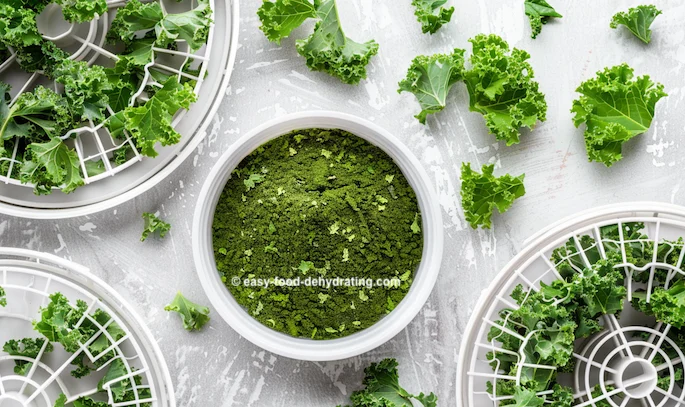
I’ll show you how to prepare and dry kale in a food dehydrator, use an oven when you don’t have a dehydrator, test it for doneness, and store it properly. We’ll also cover kale chips and kale powder—including a little help from Minnie, who remains thoroughly unconvinced about eating kale!
Two Reliable Ways to Dehydrate Kale at Home
1. Electric food dehydrator: The best choice for steady temperature, consistent airflow, and dependable results.
2. Regular oven: A useful alternative when you don’t have a dehydrator, although kale needs closer monitoring because ovens generally run hotter.
An electric food dehydrator gives you the most control and is my preferred method. An oven can also work, provided you use its lowest temperature and check the kale frequently to prevent scorching.
What Type of Kale Is Best for Dehydrating?
You can dehydrate any fresh kale with firm leaves and no slimy, yellowed, or badly damaged areas. Curly kale is especially good for chips because its sturdy, ruffled leaves hold seasoning well. Lacinato—also called dinosaur kale—has flatter leaves that are easy to arrange on dehydrator trays, while thinner-leaved varieties such as Red Russian kale may dry a little faster.
Don’t worry if you don’t know the variety. Proper preparation and a reliable doneness test matter more than the name on the seed packet or grocery-store label. Remove the thick center ribs, arrange similar-sized pieces together, and check thinner leaves earlier.
💡 Susan’s Tip: Any variety can be ground into kale powder once it is completely brittle and crumbles easily between your fingers.
How to Prepare Kale for Dehydrating
Start with fresh, firm kale leaves. Avoid leaves with slimy areas, extensive yellowing, or signs of spoilage. Then prepare the kale as follows:
- Wash thoroughly: Rinse the leaves under cool running water, paying particular attention to the folds in curly kale where dirt can hide.
- Dry well: Use a salad spinner or blot the leaves with clean kitchen towels. Excess surface water makes drying take longer.
- Remove the thick ribs: Fold each leaf in half and pull or cut away the tough center rib. Thick ribs dry much more slowly than the leaves.
- Tear into pieces: Make larger pieces for kale chips and moderately sized pieces for flakes or powder. Kale shrinks considerably as it dries, so don’t make the pieces too small.
For kale chips, try to keep the pieces reasonably similar in size so they finish drying at approximately the same time. For flakes or powder, exact sizing matters less because the completely dried leaves will be crumbled or ground afterward.
Do you need to blanch kale before dehydrating it? For kale chips that will be eaten fairly soon, you can dry the thoroughly washed raw leaves. For plain dried kale intended for longer storage, blanching is recommended to improve quality and reduce microorganisms before drying. Steam-blanch the prepared leaves until wilted for approximately 2–2½ minutes, or water-blanch them for approximately 1½ minutes. Cool, drain, and dry the leaves thoroughly before placing them on the dehydrator trays.
How to Dehydrate Kale in a Food Dehydrator
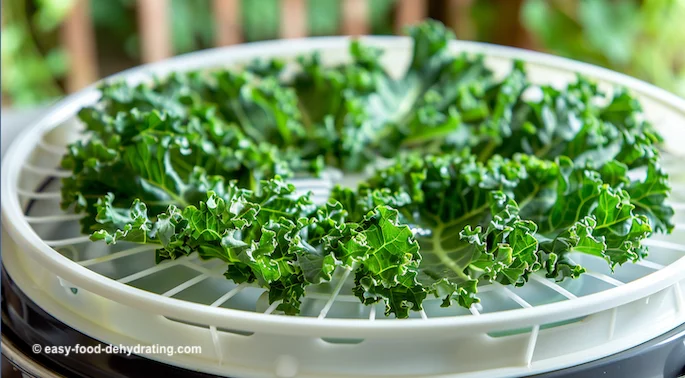
- Prepare the kale: Wash the leaves thoroughly, dry them well, remove the thick center ribs, and tear the leaves into reasonably even pieces.
- Blanch when appropriate: If you are preparing plain kale for longer storage, blanch it using the directions above, then cool, drain, and dry it thoroughly.
- Load the trays: Arrange the kale in a single layer. The leaves can sit fairly close together, but avoid piling or folding them over one another.
- Set the dehydrator: Dry the kale at 125°F (52°C).
- Begin checking after 3–4 hours: Thin leaves and small pieces may finish first. Remove any completely dry pieces and continue drying the rest.
- Continue until brittle: Most kale will take approximately 4–6 hours, although thick leaves, crowded trays, high humidity, and different dehydrator models can extend the drying time.
- Cool and test: Let a few pieces cool before testing them. Properly dried kale should be crisp and brittle, with no soft, cool, damp, or flexible areas. Leaves intended for powder should crumble easily between your fingers.
💡 Susan’s Tip: Drying time is always a guide—not a deadline. Trust the doneness test more than the clock.
💡 Outside the United States? Use my quick Fahrenheit-to-Celsius converter to find the equivalent Celsius temperature.

A Little Kale Fun with Minnie
Minnie has some definite opinions about kale—and her expression says nearly everything! Here she is helping me in the kitchen while I get the kale ready for the dehydrator.

How to Dehydrate Kale in an Oven
You can use a regular oven when you don’t have a food dehydrator, but ovens generally run hotter and provide less airflow. Watch the kale closely because the thin leaves can go from dry to scorched surprisingly quickly.
- Prepare the kale: Wash and dry the leaves thoroughly, remove the thick center ribs, and tear the leaves into reasonably even pieces.
- Arrange on baking sheets: Spread the kale in a single layer on parchment-lined baking sheets. Do not pile the leaves.
- Use the lowest oven temperature: Set the oven to its lowest available setting—ideally between 140°F and 170°F.
- Provide airflow when appropriate: If your oven’s instructions permit it, leave the door slightly ajar so moisture can escape. Do not do this with a gas oven or any oven whose manufacturer warns against operating with the door open.
- Rotate and check frequently: Rotate the baking sheets and gently turn or rearrange the leaves as needed. Begin checking after approximately 30 minutes.
- Dry until completely brittle: Depending on the oven temperature, leaf thickness, and amount of kale, drying may take approximately 1–3 hours. Remove finished pieces as they become crisp and continue drying any flexible pieces.
- Cool before testing: Properly dried kale should remain crisp and brittle after cooling, with no soft or damp areas.
Because every oven behaves differently, use the time only as a guide. The cooled doneness test is more dependable than the clock.
If you frequently use your oven for drying food, see my guide to dehydrating food in convection ovens for more tips on temperature and airflow.
Can You Sun-Dry Kale?
I don’t recommend sun-drying kale. The National Center for Home Food Preservation advises drying vegetables indoors under the controlled conditions provided by a food dehydrator or oven. Outdoor temperature and humidity fluctuate, while insects, dust, nighttime condensation, and slow drying increase the possibility of contamination or spoilage. This is particularly important in humid climates—like mine here in Florida.
Dehydrated Kale Chips with Easy Flavor Ideas

These light, crispy kale chips are easy to customize. Use only a small amount of oil so the leaves become crisp rather than greasy, and choose whichever seasoning variation appeals to you.
Ingredients
- 1 bunch curly kale
- 2 teaspoons olive oil, adding a little more only if needed
- 1/4 teaspoon salt, or to taste
- 1/4 teaspoon black pepper
Optional flavor ideas—choose one:
- Spicy: Add 1/4 teaspoon crushed red pepper flakes.
- Mediterranean: Add 1/2 teaspoon dried oregano and 1/4 teaspoon garlic powder.
- Sesame ginger: Replace the olive oil with 2 teaspoons toasted sesame oil and add 1/4 teaspoon ground ginger.
- Lemon pepper: Add 1/4 teaspoon dried lemon zest and an additional 1/4 teaspoon black pepper.
How to Make Dehydrated Kale Chips
- Prepare the kale: Wash and thoroughly dry the leaves. Remove the thick center ribs and tear the leaves into bite-sized pieces.
- Add the oil: Place the kale in a large bowl and massage in 2 teaspoons of oil, making sure the leaves are lightly—not heavily—coated.
- Season: Add the salt, pepper, and one optional flavor variation. Toss until evenly distributed.
- Load the dehydrator: Arrange the kale in a single layer on the trays without piling or folding the leaves.
- Dehydrate: Dry at 125°F (52°C) for approximately 4–6 hours. Begin checking after 3 hours and remove any chips that finish early.
- Test for doneness: Let a chip cool before testing it. It should be completely crisp and brittle, with no soft or flexible areas.
- Cool and store: Allow the chips to cool completely before placing them in an airtight container.
Oil-coated kale chips are best enjoyed fairly soon because they do not store as well as plain dried kale. If they lose their crunch but show no sign of spoilage, return them to the dehydrator briefly until they are crisp again.
How to Store Dried Kale, Kale Powder, and Chips
Allow plain dried kale to cool completely before packaging it. Warm kale can create condensation inside the container, introducing enough moisture to encourage mold.
Store completely dry kale pieces, flakes, or powder in a clean, dry, airtight container. Mason jars work especially well because the brittle leaves are protected from being crushed. Food vacuum sealer bags are another option, although the leaves’ sharp edges can sometimes puncture thin bags.
Keep the container in a cool, dry, dark location. Packing the kale in smaller portions also helps because repeatedly opening one large container exposes the entire supply to air and humidity.
An oxygen absorber or food-safe desiccant packet may be useful in certain long-term storage situations, but you do not automatically need both—especially when the kale will be used regularly. Proper drying, complete cooling, an airtight container, and protection from heat, light, and moisture are the priorities.
Seasoned kale chips containing oil are best stored separately and eaten fairly soon. They will not retain their quality as long as plain dried kale or kale powder.
For complete container and pantry-storage guidance, see my How to Store Dehydrated Food for Maximum Shelf Life guide.
How to Use or Rehydrate Dried Kale
Plain dried kale pieces and flakes can be added directly to soups, stews, casseroles, pasta sauces, and other moist dishes. They will soften as the dish cooks.
To rehydrate kale before using it, place the dried pieces in a bowl, cover them with warm water, and soak for approximately 10–15 minutes. Drain away any excess water before adding the kale to your recipe. The restored texture will be softer than fresh kale, so rehydrated kale works best in cooked dishes.
Kale powder usually does not need to be rehydrated. Stir a small amount directly into:
- Soups, stews, and sauces
- Smoothies
- Scrambled eggs or omelets
- Pasta dough or savory bread dough
- Dips and dressings
Start with a small amount because dried kale powder is concentrated, then add more according to your taste.
Seasoned kale chips are intended to be eaten crisp. Rehydrating them removes the crunch and may produce an oily texture, so use plain dried kale—not seasoned chips—when you want kale for a cooked dish.
For more guidance, see my complete Rehydrating Dehydrated Food guide.
Frequently Asked Questions About Dehydrating Kale
Do you have to blanch kale before dehydrating it?
Do you have to blanch kale before dehydrating it?
It depends on how you plan to use the kale. Raw kale works well for chips that will be eaten fairly soon. For plain dried kale intended for longer storage, blanching is recommended to improve quality and reduce microorganisms before drying. Drain and dry blanched kale thoroughly before loading the dehydrator.
How long does kale take to dehydrate?
How long does kale take to dehydrate?
Kale generally takes approximately 4–6 hours in a food dehydrator set to 125°F. Thin leaves may finish sooner, while thick leaves, crowded trays, and humid conditions can extend the time. It is ready when the cooled leaves are completely crisp, brittle, and easy to crumble.
Can you dehydrate kale stems?
Can you dehydrate kale stems?
You can dry kale stems separately, but they take considerably longer than the leaves and remain fibrous. For the most even results, remove the thick center ribs before drying the leaves. If you decide to dry the stems, cut them into small, uniform pieces and do not package them until they are completely hard and dry.
Why did my kale chips lose their crunch?
Why did my kale chips lose their crunch?
Kale chips can soften if they were not completely dry before storage or if they absorbed humidity after cooling. Return them to the dehydrator briefly until they are crisp again, let them cool completely, and place them in a clean, dry, airtight container. Using too much oil can also prevent kale chips from becoming crisp.
Now you know how to turn fresh kale into crisp chips, convenient flakes, or powder—and how to tell when it is genuinely dry enough to store.
If you’d like more tasty ways to use dried food, don’t miss my free 5 Dried Food Recipes That Actually Taste Great PDF below—featuring carrot soup, minestrone, split pea soup, spicy beef jerky, and even banana cinnamon rolls.

5 Free Dried Food Recipes
That Actually Taste Great
Put your dried food to delicious use!
Five very different recipes.
Not one dull bite...
5 Free Dried Food Recipes
That Actually Taste Great
Put your dried food to delicious use!
Five very different recipes.
Not one dull bite...
More From Easy Food Dehydrating
How to Dehydrate Corn: Frozen, Fresh, or Canned
Learn how to dehydrate frozen, fresh, or canned corn at 140°F, then cool, store, and rehydrate the dried kernels for soups, chowders, and more.
How to Dehydrate Onions: Smell-Safe Drying & Storage
Learn how to dehydrate onions with less odor: slice, dry at 125–135°F for 4–12 hours, and store safely away from pets.
How to Dehydrate Tomatoes: Powder, Sauce & Oil-Packed
Learn how to dehydrate tomatoes, then make powder, quick sauce, or oil-packed slices for pizza, soups, and gifts.
How to Dehydrate Garlic: Elephant & Regular Varieties
Learn how to dehydrate garlic - elephant and regular - for chips, powder, and long-lasting flavor.
How to Dehydrate Cauliflower for Soups, Sides & Rice
Step-by-step: blanch, dry at 125–135°F, store airtight. Perfect for soups, sides, rice, or low-carb cauliflower powder.
How to Dehydrate Mushrooms: Temperature, Time & Storage
Learn how to dehydrate mushrooms at 120°F until crisp, with preparation, drying-time, storage, rehydration, and wild-mushroom safety tips.





More From Easy Food Dehydrating
How to Dehydrate Corn: Frozen, Fresh, or Canned
Learn how to dehydrate frozen, fresh, or canned corn at 140°F, then cool, store, and rehydrate the dried kernels for soups, chowders, and more.
How to Dehydrate Onions: Smell-Safe Drying & Storage
Learn how to dehydrate onions with less odor: slice, dry at 125–135°F for 4–12 hours, and store safely away from pets.
How to Dehydrate Tomatoes: Powder, Sauce & Oil-Packed
Learn how to dehydrate tomatoes, then make powder, quick sauce, or oil-packed slices for pizza, soups, and gifts.
How to Dehydrate Garlic: Elephant & Regular Varieties
Learn how to dehydrate garlic - elephant and regular - for chips, powder, and long-lasting flavor.
How to Dehydrate Cauliflower for Soups, Sides & Rice
Step-by-step: blanch, dry at 125–135°F, store airtight. Perfect for soups, sides, rice, or low-carb cauliflower powder.
How to Dehydrate Mushrooms: Temperature, Time & Storage
Learn how to dehydrate mushrooms at 120°F until crisp, with preparation, drying-time, storage, rehydration, and wild-mushroom safety tips.
Before You Go...
If you enjoyed this page, tap the ❤️ in the lower right-hand corner.
It saves this page to your Grow bookmarks so you can find it again later.
You’ll also see quick share buttons to copy the link, post to Facebook,
or save it straight to Pinterest.
What We Mean by “Dehydrate”
Here at Easy Food Dehydrating, “dehydrate” always means using an electric food dehydrator — the easy, reliable way to dry food at home.
What We Mean by “Dehydrate”
Here at Easy Food Dehydrating, “dehydrate” always means using an electric food dehydrator — the easy, reliable way to dry food at home.


📌 Pin It for Later

LATEST READS on EFD


-
Better Than Bouillon: Uses, Storage & Cube Comparison
Sep 11, 26 10:46 AM
 Learn how to use Better Than Bouillon, how much makes one cup of broth, how it compares with cubes, and how to store opened jars safely.
 -
How to Dehydrate Bananas for Easy, Healthy Snacking
Sep 09, 26 02:32 PM
 Learn how to dehydrate bananas at 135°F, reduce browning, test for doneness, condition, and store them for delicious homemade snacks.
 -
How to Dehydrate Peas: Fresh, Frozen & Canned
Sep 09, 26 11:21 AM
 Learn how to dehydrate fresh, frozen, or canned peas with the right preparation, temperature, drying time, storage tips, and an easy glove trick!



Unlock the Secrets of Food Dehydrating... from Fruit 'n' Veg to Doggie Dinners!




AFFILIATE DISCLOSURE: I am an Affiliate for Amazon, and other sellers of quality merchandise. Should you purchase an item through their links, I may receive compensation. The price you pay does not increase. THANKS for your support! Read full disclosure here.
easy FOOD DEHYDRATING: Making food preservation simple since 2010. I show you how to keep your food pantry full, whatever the reason or season!

HOME ARTICLES CONTACT ADVERTISING DISCLOSURE DISCLAIMER FAQ PRIVACY SITEMAP TERMS TESTIMONIALS
ALL CONTENT COPYRIGHT © 2010-2025 • ALL RIGHTS RESERVED REGARDLESS OF LINKS OR ATTRIBUTIONS.
POWERED BY SBI! (SOLO BUILD IT!)
As an Amazon Associate, I earn from qualifying purchases.