
Desiccant Packets for Dehydrated Food: Storage Guide

Keeping properly dehydrated food crisp isn’t just about sealing out air—you also need to keep unwanted moisture under control. That’s where food-safe desiccant packets can help.
These small pouches absorb moisture from the air inside an airtight jar, Mylar bag, vacuum-sealer bag, or food-storage container. They can help dried foods resist softening and clumping, especially in humid conditions.
However, a desiccant packet cannot make inadequately dried food safe. Your food still needs to be dried thoroughly, conditioned when appropriate, packaged correctly, and stored in a cool, dark, dry place.
✅ Quick Answer: What are desiccant packets for dehydrated food?
Food-safe desiccant packets absorb excess moisture inside airtight food-storage containers. They can help properly dehydrated food stay dry and crisp, but they do not replace thorough drying, conditioning, airtight packaging, or correct storage. Choose packets specifically documented as suitable for food contact and follow the manufacturer’s sizing instructions.
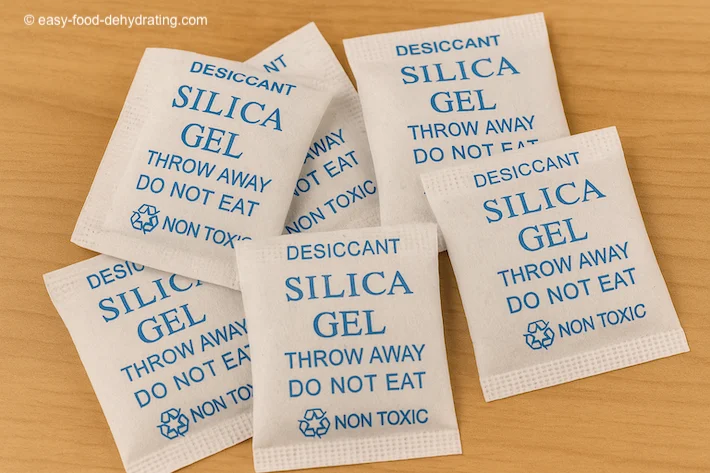
These little packets—usually filled with silica gel—absorb moisture from the air around properly dried food. Silica gel can absorb a substantial amount of moisture relative to its own weight, helping dried foods resist softening, clumping, and loss of crispness.
They are particularly useful in humid areas like ours here in Florida, where opening a storage container can allow moist air inside.
Quick heads-up: Do not assume that every desiccant packet is suitable for use with food. Buy intact packets specifically documented by the manufacturer as suitable for food contact. Never reuse packets that came with shoes, electronics, clothing, or other nonfood products.
Some blue indicating silica gel contains cobalt chloride, while other indicating packets use different chemicals. Color alone does not confirm whether a packet is food-safe, so check the manufacturer’s food-contact information. Keep all desiccant packets away from children and anyone who might mistake one for food because the packet can present a choking or swallowing hazard.
Selecting the right packet size depends on more than the name of the container. The amount of empty air inside it, the food’s sensitivity to moisture, your local humidity, the packaging material, and the particular desiccant all matter.
Manufacturers publish different capacity recommendations for their products, so use the sizing chart supplied with the packets you purchase. Do not assume that every five-gram packet protects the same container volume.

Store your opened desiccant packet bag inside a FoodSaver reusable bag, just like I do as seen in the video above!
Printable Desiccant Packet Size Guide
CLICK HERE
to PRINT OUT the chart below:
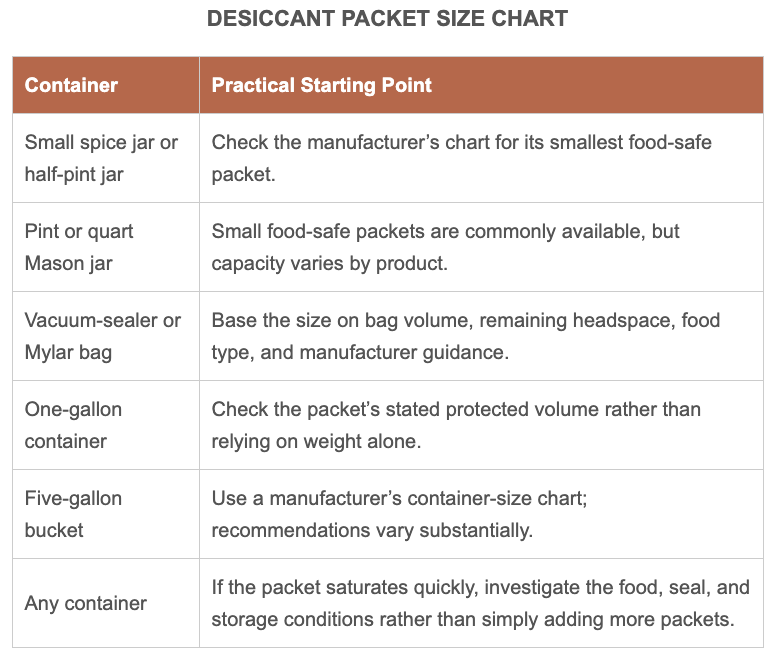
Use this chart as a starting point—not as a universal sizing rule. Desiccant products differ in capacity, and humidity, headspace, packaging, and storage conditions all affect how much protection is needed. Always compare these general ranges with the instructions supplied by your packet manufacturer.
| Container | Practical Starting Point |
|---|---|
| Small spice jar or half-pint jar | Check the manufacturer’s chart for its smallest food-safe packet. |
| Pint or quart Mason jar | Small food-safe packets are commonly available, but capacity varies by product. |
| Vacuum-sealer or Mylar bag | Base the size on bag volume, remaining headspace, food type, and manufacturer guidance. |
| One-gallon container | Check the packet’s stated protected volume rather than relying on weight alone. |
| Five-gallon bucket | Use a manufacturer’s container-size chart; recommendations vary substantially. |
| Any container | If the packet saturates quickly, investigate the food, seal, and storage conditions rather than simply adding more packets. |
★★★★★★
The page you are reading now is
ONE of the most IMPORTANT
pages on Easy Food Dehydrating
The page you
are reading now
is ONE of the most
IMPORTANT
pages on
Easy Food
Dehydrating
★★★★★★
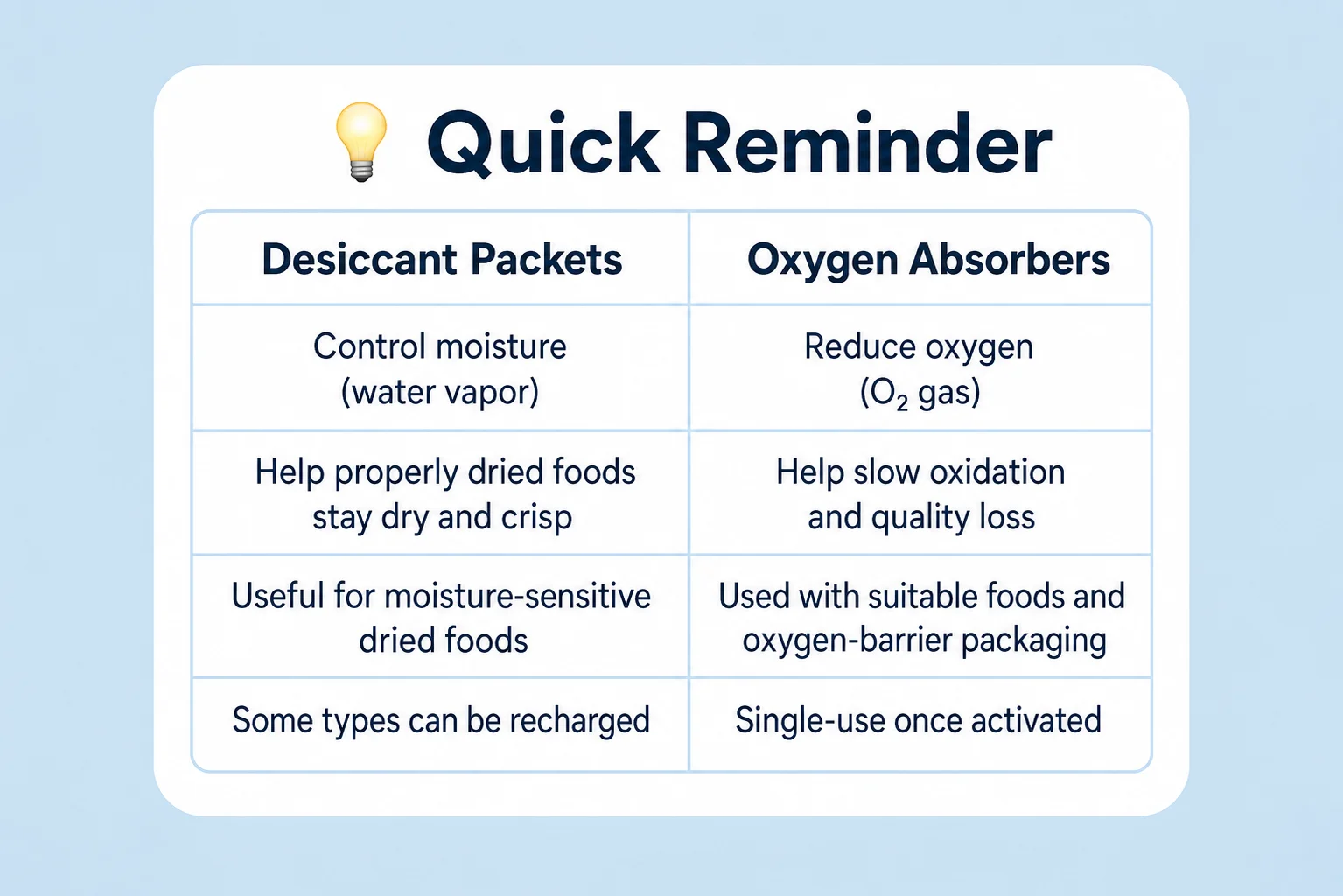
Why is that? Because properly dehydrated food can still deteriorate if moisture or oxygen gets into its storage packaging. Desiccant packets help control moisture, while oxygen absorbers reduce oxygen. They do different jobs, and whether you need one, the other, or both depends on the food, packaging, and storage method.
How Desiccant Packets Protect Dried Food
Desiccant packets control moisture—not oxygen. Silica gel works through adsorption—yes, with a “d.” Water molecules cling to the large internal surface of the silica gel instead of soaking into it as they would with a sponge.
Inside suitable airtight packaging, that moisture control can help properly dehydrated fruit, vegetables, herbs, jerky, spices, and dry snacks retain their intended texture.
A desiccant does not correct food that still contains too much moisture, and it cannot compensate for a poor seal. Dry and condition the food correctly first, then package it promptly.
🌟 Why Desiccant Packets Don't Absorb Oxygen
- Oxygen (O₂) is a gas made of two oxygen atoms. It’s not the same as water (H₂O).
- Water vapor is water molecules floating in the air — a combo of hydrogen and oxygen atoms (H₂O).
- A desiccant packet (like silica gel) is designed to attract and hold water molecules — not oxygen molecules.
- Desiccants are very "thirsty" for moisture (water vapor), but they aren't chemically reactive to plain oxygen gas floating around.
🌟 Why This Matters
- Oxygen absorbers perform a different job. Most contain iron powder that reacts with oxygen inside suitable sealed packaging. Desiccants, by contrast, attract moisture.
- One cannot automatically substitute for the other—and not every dried food or storage method needs both.
Desiccant Packets vs. Oxygen Absorbers: Which Do You Need?
Desiccant packets and oxygen absorbers are not interchangeable:
- Desiccant packets control moisture. They are especially useful when a properly dried food needs help staying crisp or resisting clumping in humid conditions.
- Oxygen absorbers reduce oxygen. They are used with suitable foods and oxygen-barrier packaging to slow oxidation and other oxygen-related deterioration.
Do not assume that every dehydrated food needs both products. Whether either—or both—is appropriate depends on the food, its moisture level, the packaging, and the products being used.
Follow the instructions supplied by the oxygen-absorber and desiccant manufacturers. Avoid relying on packet placement alone as proof that two products will work correctly together.
For more help choosing and using oxygen absorbers, see my guide to oxygen absorbers for dehydrated food.
When Should You Use Desiccant Packets for Dehydrated Food?
Desiccant packets are most useful when properly dehydrated food is especially sensitive to humidity or loses quality when it absorbs moisture. Examples can include:
- Crisp dried fruit and vegetable snacks
- Dried herbs and spices prone to clumping
- Crackers and other dry snacks
- Dry powdered ingredients
- Freeze-dried food
- Foods stored in frequently opened containers
They can be particularly helpful in humid climates. Here in Florida, moist air can enter a jar or bag every time it is opened.
A desiccant packet is not permission to package food before it has finished drying or conditioning. If you see condensation, unusual softness, moisture droplets, mold, or an off odor, do not rely on the packet to fix the problem.
A Simple Storage Checklist for Dehydrated Food
Use this checklist before adding any desiccant packet. Moisture-control packets provide extra protection only after the food and packaging are ready.
| Check | What to Do |
|---|---|
| Food is fully dehydrated | Test it using the appropriate doneness signs for that ingredient. |
| Food has cooled | Package only after it has cooled completely. |
| Conditioning is complete | Condition fruits and other foods when recommended, watching for moisture. |
| Container is suitable | Use clean, dry, airtight packaging appropriate for the intended storage period. |
| Packet is food-safe | Use a new, intact packet documented as suitable for food contact. |
| Packet size is checked | Follow the product manufacturer’s capacity or container chart. |
| Package is sealed promptly | Limit exposure to humid room air. |
| Storage area is appropriate | Keep the finished package cool, dark, and dry. |
| Package is inspected | Watch for seal failure, moisture, mold, off odors, or unexpected softening. |
Where to Buy Food-Safe Desiccant Packets
Look for new, intact packets whose manufacturer provides clear food-contact information and sizing instructions. Click the product images below to check current details and availability on Amazon.
Vbeijll Color-Indicating Silica Gel Packets - 2g
(50 count)

Vbeijll Color-Indicating Silica Gel Packets - 5g
(50 count)

Romeda Silica Gel Desiccant Packs - 5g
(55 count)

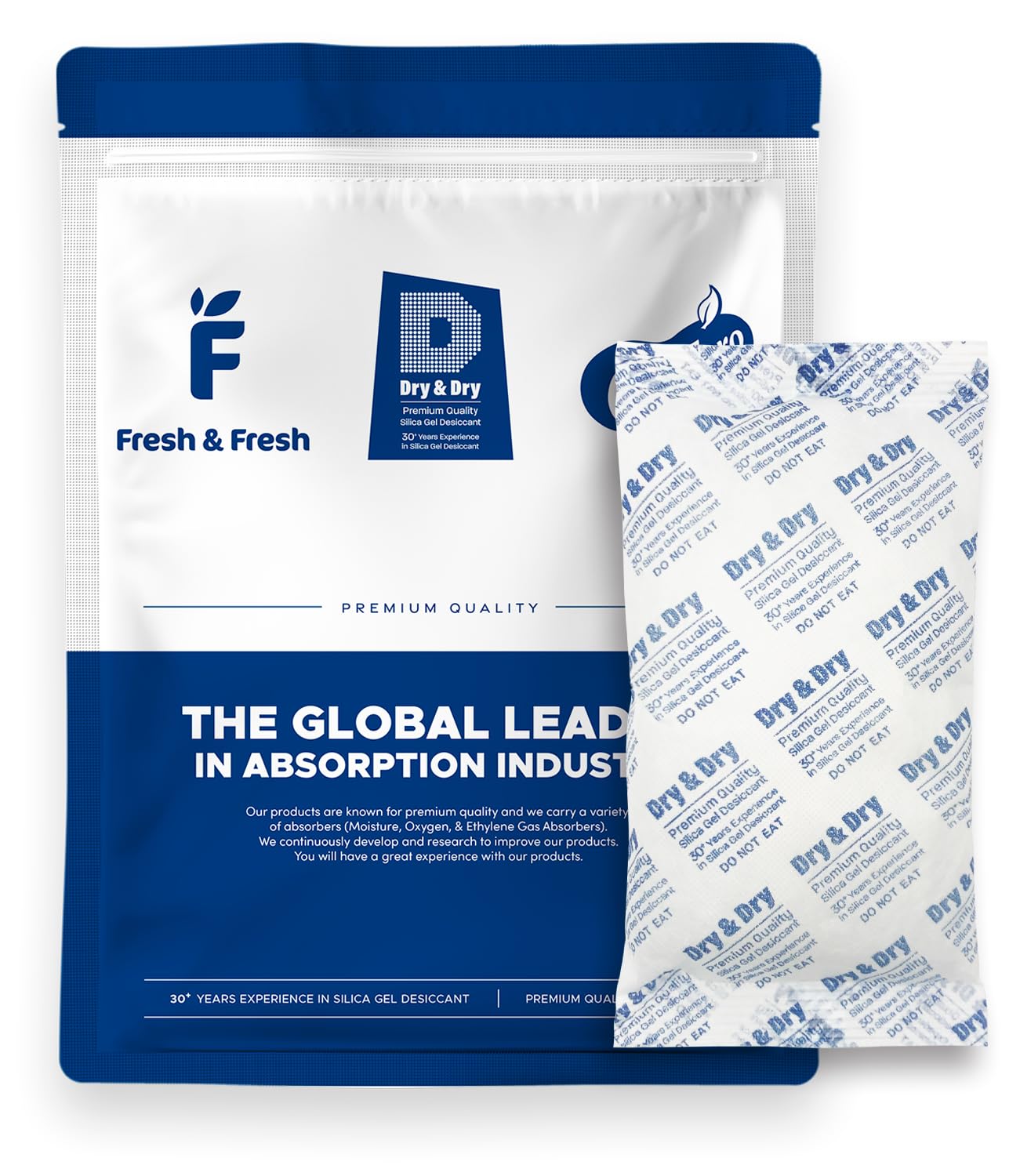
Dry & Dry Silica Gel Packets - 5g
(50 count)

Absorpak Desiccant Pouches - 5g
(200 count)

Wisedry Moisture Indicating Desiccant Packets - 5g
(60 count)

Wisesorb Silica Gel Packets - 20g
(15 count)

Romeda Silica Gel Packs - 20g
(15 count)

Silica Gel Packs Absorbers Transparent - 20g (80 count)

Absorbking Silica Gel Packets - 50g
(35 count)

WiseDry Reusable Silica Gel Desiccant Packs - 50g (10 count)

Absorbking - 100g
(12 count)

Absorbking - 100g
(16 count)
Dry & Dry - 300g
(5 count)
As an Amazon Associate, I earn from qualifying purchases—this does not affect the price you pay. Read full disclosure.
Pro Tips for Storing and Reusing Desiccant Packets
If you're using desiccant packets to protect your dehydrated foods, you’ll want to keep them in good shape so they keep doing their job. Here’s how to make the most of them:
Store extras in airtight packaging:
Once you open the original package, reseal unused packets promptly in an airtight jar, Mylar bag, or vacuum-sealer bag. Desiccants begin collecting moisture from room air as soon as they are exposed.
I vacuum-seal my opened packet bag inside a FoodSaver reusable bag, as shown in my video above.
🛠️ Pro Tip: Always have a few extra airtight jars or small vacuum bags ready for resealing unused desiccant packets. Resealing them promptly helps preserve their remaining moisture-absorbing capacity until you need them.
Follow the indicator instructions:
Some rechargeable packets contain an indicator that changes color as the desiccant collects moisture. Check the manufacturer’s instructions to learn what the colors mean and whether that particular product is documented as suitable for use with food.
Recharge only packets designed for reuse:
Some silica-gel packets can be recharged, but packet materials and heating instructions vary. Only heat a packet if its manufacturer identifies it as reusable. Follow the stated oven temperature, timing, cooling, and microwave directions exactly.
Once cooled as directed, reseal the packets promptly so they do not begin absorbing moisture from the room again.
Label recharged packets if needed:
If you’re recharging in batches, you might want to label the bag with a small sticker or note so you know which ones are fresh and ready to go!
Discard damaged packets:
Do not use a packet that is torn, leaking, stained, or has an unusual odor. If the packet breaks open inside a food container, follow the product manufacturer’s guidance. When in doubt, discard the affected food rather than risk contamination.
Can Vacuum Sealing Damage a Desiccant Packet?
A well-made packet may tolerate ordinary household vacuum sealing, but packet materials and sealers vary. Inspect the packet before and after sealing, and do not use one that appears crushed, torn, or punctured.
Avoid placing sharp-edged dried foods directly against the packet. If you are unsure whether a particular packet is suitable for vacuum-sealer bags, check with its manufacturer.
I also vacuum-seal the opened outer bag of my unused desiccant packets inside a FoodSaver reusable bag. That keeps the unused packets from absorbing moisture while they wait to be used.
Frequently Asked Questions About Desiccant Packets for Dehydrated Food
If you're serious about keeping dehydrated foods crisp and safe, knowing how to properly use desiccant packets is important.
What are desiccant packets?
What are desiccant packets?
Desiccant packets contain moisture-adsorbing material such as silica gel or clay. Food-safe packets can help properly dried food resist moisture-related softening and clumping inside suitable airtight packaging.
Are desiccant packets safe for food?
Are desiccant packets safe for food?
They can be used with food when the manufacturer specifically documents the complete packet—including its contents and wrapper—as suitable for food contact. Do not reuse packets obtained from shoes, electronics, clothing, or other nonfood products.
Can desiccant packets be reused?
Can desiccant packets be reused?
Some can. Only recharge packets that the manufacturer identifies as reusable, and follow that product’s heating and cooling instructions. Discard any packet that is damaged or whose identity and previous use are unknown.
When should I use desiccant packets instead of oxygen absorbers?
When should I use desiccant packets instead of oxygen absorbers?
Use a desiccant when the main goal is controlling moisture and helping properly dried food retain its texture. Oxygen absorbers serve a different purpose by reducing oxygen inside appropriate sealed packaging. The correct choice depends on the food, packaging, and storage goal; one does not automatically replace the other.
How many desiccant packets do I need per container?
How many desiccant packets do I need per container?
Check the sizing instructions for the specific packet you purchase. Capacity varies by product, and the correct amount also depends on container volume, empty headspace, humidity, packaging, food type, and storage conditions. See my printable starting guide earlier on this page.
Does a food vacuum sealer crush or hurt desiccant packets?
Does a food vacuum sealer crush or hurt desiccant packets?
Household vacuum sealing may be suitable for some well-made packets, but packet materials and sealers vary. Inspect the packet for crushing, tearing, or punctures and follow the packet manufacturer’s packaging instructions.
Thanks for stopping by to learn about desiccant packets for dehydrated food! Used correctly, a suitable food-safe packet can provide helpful extra moisture control—but your best protection still begins with thorough drying, proper conditioning, airtight packaging, and cool, dark, dry storage.
And while you’re here, don’t miss my 5 Easy Dried Food Recipes That Actually Taste Great PDF below—featuring carrot soup, minestrone, split pea soup, spicy beef jerky, and even banana cinnamon rolls.

5 Free Dried Food Recipes
That Actually Taste Great
Put your dried food to delicious use!
Five very different recipes.
Not one dull bite...
5 Free Dried Food Recipes
That Actually Taste Great
Put your dried food to delicious use!
Five very different recipes.
Not one dull bite...
More From Easy Food Dehydrating
Plastic-Lidded Bins for Long-Term Food Storage Choices
Plastic-lidded bins keep dehydrated foods protected. Get airtight, sizing, and setup tips for long-term storage.
Feed Buckets With Lids: Safe Long-Term Food Storage
Food-grade feed buckets with lids keep dehydrated foods safe—airtight, pest-free, and stackable for long-term storage.
Food Vacuum Sealer Bags: Best Picks for Dehydrated Food
How to choose the best food vacuum sealer bags for dehydrated food—thickness, texture, sealing tips, and FAQs included!
Use Mason Jars for Storing Dehydrated Food Long Term
Airtight, reusable Mason jars keep dehydrated foods fresh & visible—perfect for quick daily use and long-term storage.
Food Vacuum Sealer Instructions: FoodSaver V2240 Part 2
Follow step-by-step FoodSaver V2240 instructions for placing bags, vacuum sealing, heat-sealing Mylar bags, checking seals, and avoiding common mistakes.
Dehydrated Food Storage Wall: Easy DIY Pantry Hub
Build a dehydrated food storage wall with DIY tips, cost-saving ideas, and photos to inspire your pantry plan.

More From Easy Food Dehydrating
Plastic-Lidded Bins for Long-Term Food Storage Choices
Plastic-lidded bins keep dehydrated foods protected. Get airtight, sizing, and setup tips for long-term storage.
Feed Buckets With Lids: Safe Long-Term Food Storage
Food-grade feed buckets with lids keep dehydrated foods safe—airtight, pest-free, and stackable for long-term storage.
Food Vacuum Sealer Bags: Best Picks for Dehydrated Food
How to choose the best food vacuum sealer bags for dehydrated food—thickness, texture, sealing tips, and FAQs included!
Use Mason Jars for Storing Dehydrated Food Long Term
Airtight, reusable Mason jars keep dehydrated foods fresh & visible—perfect for quick daily use and long-term storage.
Food Vacuum Sealer Instructions: FoodSaver V2240 Part 2
Follow step-by-step FoodSaver V2240 instructions for placing bags, vacuum sealing, heat-sealing Mylar bags, checking seals, and avoiding common mistakes.
Dehydrated Food Storage Wall: Easy DIY Pantry Hub
Build a dehydrated food storage wall with DIY tips, cost-saving ideas, and photos to inspire your pantry plan.
Before You Go...
If you enjoyed this page, tap the ❤️ in the lower right-hand corner. It saves this page to your Grow bookmarks so you can find it again later.
You’ll also see quick share buttons to copy the link, post to Facebook, or save it straight to Pinterest.

Test Your Food-Dehydrating
Know-How
Choose a food, make the right preparation, drying, and storage decisions—and see how many stars you can earn!
Play “Save the Harvest”Test Your Food-Dehydrating
Know-How
Choose a food, make the right preparation, drying, and storage decisions—and see how many stars you can earn!
What We Mean by “Dehydrate”
Here at Easy Food Dehydrating, “dehydrate” always means using an electric food dehydrator — the easy, reliable way to dry food at home.
What We Mean by “Dehydrate”
Here at Easy Food Dehydrating, “dehydrate” always means using an electric food dehydrator — the easy, reliable way to dry food at home.


📌 Pin It for Later

LATEST READS on EFD


-
How to Dehydrate Citrus Slices: Lemons, Limes & Oranges
Sep 19, 26 03:28 PM
 Learn how to dehydrate citrus slices at 135°F. Easy steps for lemons, limes, and oranges with tips for checking doneness, conditioning, and storage.
 -
How to Dehydrate Cabbage: Temperature, Storage & Creamy Slaw
Sep 19, 26 11:57 AM
 Learn how to dehydrate cabbage at 125°F, including how to prepare, steam-blanch, test for doneness, condition, store, rehydrate, and make creamy coleslaw.
 -
How to Make Homemade Dog Food: Chicken & Beef Recipes
Sep 18, 26 01:11 PM
 Meet Chicken Chow-Chow and Bow Wow Beefy Chow, learn how I prepared Minnie’s meals, and discover what to consider before feeding homemade dog food daily.


Unlock the Secrets of Food Dehydrating... from Fruit 'n' Veg to Doggie Dinners!




AFFILIATE DISCLOSURE: I am an Affiliate for Amazon, and other sellers of quality merchandise. Should you purchase an item through their links, I may receive compensation. The price you pay does not increase. THANKS for your support! Read full disclosure here.
easy FOOD DEHYDRATING: Making food preservation simple since 2010. I show you how to keep your food pantry full, whatever the reason or season!

HOME ARTICLES CONTACT ADVERTISING DISCLOSURE DISCLAIMER FAQ PRIVACY SITEMAP TERMS TESTIMONIALS
ALL CONTENT COPYRIGHT © 2010-2025 • ALL RIGHTS RESERVED REGARDLESS OF LINKS OR ATTRIBUTIONS.
POWERED BY SBI! (SOLO BUILD IT!)
As an Amazon Associate, I earn from qualifying purchases.