- Home
- How to Dehydrate Fruit
- How to Dehydrate Strawberries
- Strawberries: Air Fryer and Dehydrator Methods

How to Dehydrate Strawberries in an Air Fryer or Dehydrator

Dehydrating strawberries in an air fryer is an easy way to preserve a small batch of ripe berries and turn them into naturally sweet snacks. The key is using an air fryer that can maintain a low temperature — ideally around 135°F (57°C) — without cooking or browning the fruit.
An electric dehydrator is still my preferred appliance because it provides more tray space and is designed to maintain the steady, low heat that fruit needs. However, an air fryer with a dehydrating setting can work very well when you only have a handful of strawberries to dry.
My two air fryers don’t go low enough for fruit, so I dried my strawberries in my Elite Gourmet dehydrator. I’ll also show you Samantha’s results using a Ninja Foodi and stacking wire rack so you can compare both methods.
✅ Quick Answer: How do you dehydrate strawberries in an air fryer?
Wash and thoroughly dry the strawberries, remove the hulls, and cut the berries into even slices about 1/8 to 1/4 inch thick. Arrange them in a single layer on a wire rack, mesh liner, or perforated parchment. Set the air fryer to its dehydrating setting or approximately 135°F. Dry for about 2½ to 6 hours, checking regularly, until the slices feel dry and leathery with no moist or sticky areas. Cool and condition the strawberries before placing them into long-term storage.

How to Dehydrate Strawberries in an Air Fryer
Air fryers are best suited to small batches because their drying area is much smaller than a dehydrator tray. If your air fryer has a dehydrating setting and enough space for air to circulate around the strawberry slices, however, the method is straightforward.
- Wash and dry the strawberries. Rinse them gently and pat them completely dry. Starting with wet berries adds unnecessary drying time.
- Remove the hulls. A strawberry huller removes the leaves and firm center without cutting away the entire top of the berry.
- Slice the berries evenly. Cut them approximately 1/8 to 1/4 inch thick. Thin slices usually dry faster and become crisper; thicker slices tend to remain chewier.
- Arrange them in one layer. Leave a little room around each slice and don’t allow the pieces to overlap.
- Use a surface that allows airflow. A wire rack, mesh liner, or perforated parchment is better than covering the entire basket with solid parchment.
- Set the temperature to approximately 135°F (57°C). Use the appliance’s dehydrating setting if it has one.
- Begin checking after 2½ hours. Depending on the appliance, slice thickness, berry moisture, rack arrangement, and humidity, the total drying time may be approximately 2½ to 6 hours or longer.
- Turn or rearrange the slices if necessary. Airflow may be stronger in some parts of the basket than others.
- Check for dryness. Let a test piece cool before judging it. Properly dried strawberries should feel dry and leathery, with no visible moisture or sticky areas when cut or torn.
- Cool and condition before storage. Don’t package warm fruit because trapped heat can cause condensation.
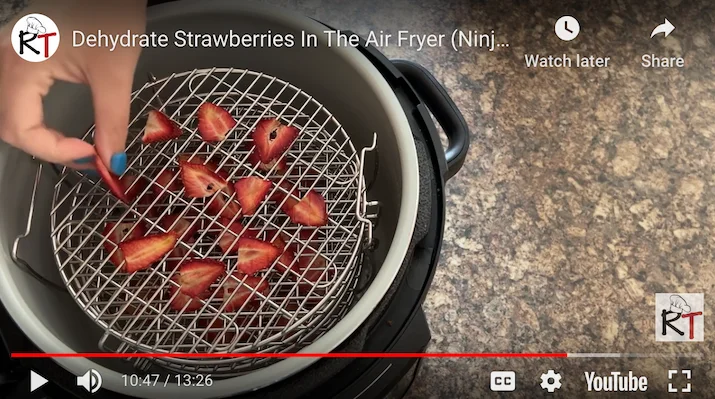 This is a screenshot from Samantha’s RecipeThis.com video—not the video itself.
You can watch her complete air-fryer demonstration farther down the page.
Susan’s Tip: My air fryers don’t reach 135°F, and I consider 180°F too hot for dependable fruit dehydration. If your air fryer’s lowest temperature is 180°F, monitor the berries very closely and expect more browning and a greater risk of cooking the outside before the center has dried.
💡 Outside the United States? Use my quick Fahrenheit-to-Celsius converter to find the equivalent Celsius temperature.
🍓 How to Choose the Best Strawberries for Dehydrating
Start with ripe, flavorful strawberries that you would be happy to eat fresh. Drying concentrates their flavor, but it cannot turn bland berries into delicious ones.
Look for strawberries with:
- Bright, even red color
- Fresh green leaves
- A firm texture without mushy areas
- A naturally sweet strawberry aroma
Avoid berries with mold, leaking juice, or soft, damaged areas. Strawberries with large white or green patches may not be fully ripe, while extremely dark, soft berries may be overripe. Save those soft-but-unspoiled berries for smoothies instead.
Organic strawberries are grown without most conventional synthetic pesticides, but they often cost more and may deteriorate faster. Regular strawberries are generally less expensive and easier to find. I prioritize freshness, ripeness, and flavor over the label, then wash the berries thoroughly before using them.
Locally grown strawberries in season are often especially flavorful—but the best berries are the ripe, sound ones available to you.
How to Prepare Strawberries for Drying
Gently rinse the strawberries and pat them thoroughly dry. Remove the leafy tops and hulls, then slice the berries as evenly as possible.
I use an OXO Good Grips strawberry huller because it removes the stem and firm center without wasting the top portion of the strawberry. It is also far easier than trying to dig the hulls out with my fingernails!
For drying, cut each berry into slices approximately 1/8 to 1/4 inch thick. Consistent thickness helps the pieces finish at roughly the same time, but there’s no need to chase perfection. You can always remove the smaller pieces first and continue drying the thicker ones.


OXO Good Grips Strawberry Hullers
You WON'T be sorry you got this handy dandy hulling tool...
As an Amazon Associate, I earn from qualifying purchases. The price you pay does not increase. Read my disclosure here.
Four Easy Preparation Steps
- Wash and thoroughly dry the berries.
- Remove the leaves, stems, and hulls.
- Slice the berries evenly.
- Arrange the slices in one layer without overlapping.
An air fryer’s main limitation is its small drying area. A stacking wire rack can increase the usable space and improve airflow, provided the rack is designed to fit your particular appliance without interfering with the fan or heating element.
Goldlion Dehydrator Rack for Ninja Foodi (Amazon affiliate link—thank you!)

As an Amazon Associate, I earn from qualifying purchases. The price you pay does not increase. Read my disclosure here.
Samantha’s Air Fryer Strawberry Method
At approximately five minutes into her video, Samantha from RecipeThis.com demonstrates drying strawberries in a Ninja Foodi using a stacking wire rack. The extra levels allow her to dry more strawberry slices while still leaving room for air to circulate.
Samantha lightly sprays her strawberries with extra-virgin olive oil and adds Stevia. Oil is not necessary for dehydrating strawberries, and I would leave it off berries intended for longer pantry storage. If you want extra sweetness, a small amount of Stevia or sugar can be sprinkled on the slices before drying — but ripe strawberries are usually sweet enough without it.
Samantha reports that her strawberries took approximately 2½ hours in her Ninja Foodi. That is much faster than my dehydrator, but don’t assume every air fryer will match her result. Drying time varies with the model, temperature, airflow, number of racks, berry thickness, moisture level, and even the humidity in your home.
And here’s a small-world moment: Samantha and her husband, Dom, are from Yorkshire — the next county over from Lancashire, where I was born!

How to Dehydrate Strawberries in a Dehydrator
An electric dehydrator is still my first choice for strawberries because it is specifically designed to maintain low heat while moving air across multiple trays.
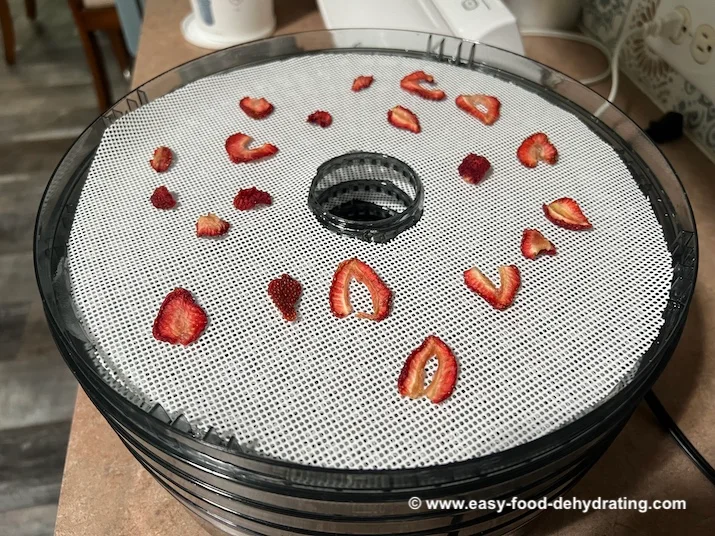
For my own demonstration, I dried a small handful of strawberry slices in my Elite Gourmet dehydrator. Neither of my air fryers goes low enough, so the dehydrator was the better tool for the job.
To use a dehydrator:
- Prepare and slice the strawberries as described above.
- Arrange the slices directly on the trays in a single layer without overlapping.
- Set the dehydrator to 135°F (57°C).
- Dry for approximately 6 to 10 hours, checking periodically. Your actual time may be shorter or longer.
- Rotate the trays if your dehydrator dries some levels faster than others.
- Remove individual pieces as they finish rather than allowing thin slices to over-dry while you wait for thicker ones.
- Let a test piece cool. It should be dry and leathery with no moisture remaining in the center.
I only had a handful of strawberries available for the demonstration, but the same method works with a full tray—or several trays—provided the slices have room for air to circulate.
What to Look for in an Air Fryer for Dehydrating
The brand name is less important than the appliance’s actual temperature range and airflow. Before buying an air fryer specifically for dehydrating, check the manufacturer’s current manual or specifications for:
- A dedicated dehydrating mode
- A temperature setting close to 135°F
- Enough room for the air to circulate around the food
- Compatible stacking racks or mesh trays
- A timer that can run for several hours
- Trays and racks that are easy to remove and clean
Some air fryers begin at 170°F or 180°F even when they advertise multiple cooking functions. That may be useful for ordinary air frying, but it is not my first choice for slowly drying fruit.
Reliable Air Fryer Models on Amazon


Why 135°F Is the Best Temperature for Strawberries
Fruit needs gentle heat and steady airflow so moisture can move from the center of each piece to the surface and escape.
When the temperature is too high, the outside of a strawberry slice can dry and harden before enough moisture has escaped from the center. This is known as case hardening. A piece may appear dry on the surface while remaining moist inside, which increases the risk of mold and spoilage during storage.
That is why I recommend drying strawberries at approximately 135°F (57°C) whenever possible. If your air fryer cannot maintain a temperature near 135°F, a dehydrator is the more dependable choice.
Drying time is only a guide. Strawberries are finished when they are dry and leathery, with no visible moisture or sticky areas. Tear or cut a thicker piece and check the center after it has cooled. Warm fruit feels softer than cool fruit, so always let your test piece return to room temperature before deciding whether the batch is done.
How to Condition and Store Dehydrated Strawberries
Let the dried strawberries cool completely before packaging them. Placing warm fruit into a sealed container can create condensation—and moisture is exactly what we worked so hard to remove.
Condition the Strawberries First
Conditioning helps distribute the small amount of moisture remaining among the pieces and reveals strawberries that need additional drying.
- Loosely place the cooled strawberries in a clean, dry glass or food-safe plastic container.
- Seal the container and leave it at room temperature for 7 to 10 days.
- Shake or turn the container once a day so the pieces move around.
- Watch for condensation, pieces sticking together, or any other sign of moisture.
- If condensation appears, return the entire batch to the dehydrator and dry it longer. Cool the fruit and begin the conditioning check again.
- Discard the batch if you see mold.
Once the conditioned strawberries show no moisture, package them in an airtight Mason jar or a properly sealed vacuum-sealer bag. Store them in a cool, dark, dry place. Light, heat, air, and humidity gradually reduce the color, flavor, and overall quality of dried food.
Here in humid Florida, I pay particular attention to keeping the container closed and dry. A food-safe desiccant packet can help manage humidity after the strawberries have been dried and conditioned properly. An oxygen absorber may help protect quality in suitable airtight packaging, but neither packet can make incompletely dried fruit safe.
For best quality, use home-dried fruit within about one year. Check it whenever you open the container and discard it if you notice mold, moisture, an unusual odor, or other signs of spoilage.
Properly packaged dried strawberries may also be kept in the refrigerator or freezer. If frozen, allow the unopened package to return to room temperature before opening it. That helps prevent humid air from condensing directly on the cold fruit.
Ways to Use Dehydrated Strawberries
Dehydrated strawberries are delicious straight from the jar, but their concentrated flavor makes them useful in far more than snack mixes.
Try them:
- Stirred into oatmeal, cereal, granola, or yogurt
- Added to homemade energy bars
- Mixed with almonds, coconut flakes, and dark chocolate for trail mix
- Crushed into powder for frosting, whipped cream, smoothies, or flavored sugar
- Folded into muffin, scone, biscuit, or cookie batter
- Sprinkled over ice cream or cheesecake
- Paired with goat cheese, nuts, and crackers on a charcuterie board
- Dipped halfway into melted chocolate for a simple treat
- Packed for backpacking, where their light weight is a real advantage
How to Rehydrate Dried Strawberries
Place the dried strawberry slices in a bowl and cover them with cool or warm water. Let them soak until softened, then drain any excess liquid.
Rehydrated strawberries won’t regain the firm texture of fresh berries, but they work well in sauces, compotes, oatmeal, baked goods, and blended recipes. Save the soaking liquid, too — it may contain plenty of strawberry flavor.
Frequently Asked Questions
How long does it take to dehydrate strawberries in an air fryer?
How long does it take to dehydrate strawberries in an air fryer?
Allow approximately 2½ to 6 hours at around 135°F, but treat that as a starting range rather than a guarantee. Thickness, berry moisture, air-fryer design, airflow, load size, and household humidity all affect the drying time. Samantha’s Ninja Foodi batch took approximately 2½ hours; another appliance may take considerably longer.
What temperature should I use to dehydrate strawberries in an air fryer?
What temperature should I use to dehydrate strawberries in an air fryer?
Use the dehydrating setting or approximately 135°F (57°C). If the lowest setting is 180°F, the appliance may cook or brown the outside before the center has dried adequately. Monitor the fruit closely or use a dehydrator instead.
How do I know when dehydrated strawberries are done?
How do I know when dehydrated strawberries are done?
Let a test piece cool, then tear or cut it. It should feel dry and leathery without visible moisture, stickiness, or a soft, wet center. Smaller pieces may finish before larger ones.
How do I make chewy rather than crispy strawberries?
How do I make chewy rather than crispy strawberries?
Cut the berries toward the thicker end of the range—approximately 1/4 inch—and begin checking early. The slices can remain pliable, but they must not feel wet or sticky inside. Never stop drying early merely to create a softer texture if moisture remains.
Do I need parchment paper in the air fryer?
Do I need parchment paper in the air fryer?
Not necessarily. A wire rack or food-safe mesh liner usually allows better airflow. If you use parchment, choose perforated parchment and make sure it is held securely beneath the food according to the air-fryer manufacturer’s directions. Solid parchment covering the basket can restrict circulation.
Can I stack strawberry slices in the air fryer?
Can I stack strawberry slices in the air fryer?
Yes, if it reaches 135°F and uses circulating air. For best results, use stackable racks and monitor dryness frequently. Arrange the fruit in a single layer and check it periodically to ensure even drying. In Sam's video, she bought a stacking wire tray rack that fits inside her Nina Foodi.
Can I add sugar, Stevia, cinnamon, or other seasonings?
Can I add sugar, Stevia, cinnamon, or other seasonings?
Yes. A light sprinkle of sugar, Stevia, cinnamon, or nutmeg can be added before drying. Taste the berries first, though — ripe strawberries develop concentrated sweetness as they lose moisture and may not need anything added.
Should I spray strawberries with olive oil before dehydrating them?
Should I spray strawberries with olive oil before dehydrating them?
No oil is required. Samantha uses a light olive-oil spray in her demonstration, but I would omit oil from strawberries intended for longer pantry storage.
Can I dehydrate strawberries in an oven?
Can I dehydrate strawberries in an oven?
Yes, although many ovens do not maintain temperatures as low as 135°F. Use the lowest safe setting your oven permits, arrange the slices on racks for airflow, and monitor them closely so they dry rather than cook. Drying time will depend heavily on the oven’s lowest temperature and airflow.
Can an air fryer really work as a dehydrator?
Can an air fryer really work as a dehydrator?
Yes — if it can maintain a suitably low temperature and circulate air continuously. An air fryer is practical for small batches, while a dehydrator offers far more drying space and is designed specifically for long, low-temperature operation.
How long do dehydrated strawberries last?
How long do dehydrated strawberries last?
For best quality, plan to use properly dried, conditioned, and packaged strawberries within about one year. Their actual keeping quality depends on how thoroughly they were dried and how well they are protected from heat, moisture, light, and air.
Now that you know how to dry strawberries like a pro, why stop there? Grab your free copy of 5 Dried Food Recipes That Actually Taste Great PDF below—featuring carrot soup, minestrone, split pea soup, spicy beef jerky, and even banana cinnamon rolls.

5 Free Dried Food Recipes
That Actually Taste Great
Put your dried food to delicious use!
Five very different recipes.
Not one dull bite...
5 Free Dried Food Recipes
That Actually Taste Great
Put your dried food to delicious use!
Five very different recipes.
Not one dull bite...
You Might Like These
How to Dehydrate Fruit Rolls: Easy Fruit Leather Guide
Make fruit rolls with fresh, frozen, or canned fruit. Dry at 135–140°F for chewy, kid-approved leathers.
How to Dehydrate Berries (Blueberries & Cranberries)
Blueberries & cranberries, dried to perfection! Simple temps, times, and tips for chewy snacks or long-term pantry storage.
How to Dehydrate Strawberries for Snacks and Smoothies
How to dehydrate strawberries for snacks, cereals, and smoothies, with step-by-step preparation, drying, and storage tips.
How to Dehydrate Peaches for Snacks & Recipes
Learn how to dehydrate peaches for snacks, smoothies, and cobblers. Step-by-step tips for drying and storing peaches.
Dehydrate Apples for Snacks and Pantry Storage
Learn how to dehydrate apples in a food dehydrator: prevent browning, dry at 125–135°F, test for doneness, and store them for snacks, pies, and more.
How to Dehydrate Plums for Prunes and Snacks
Learn how to dehydrate plums at 135°F for chewy prunes or crisp chips, with preparation, drying times, doneness tests, conditioning, and storage.




You Might Like These
How to Dehydrate Fruit Rolls: Easy Fruit Leather Guide
Make fruit rolls with fresh, frozen, or canned fruit. Dry at 135–140°F for chewy, kid-approved leathers.
How to Dehydrate Berries (Blueberries & Cranberries)
Blueberries & cranberries, dried to perfection! Simple temps, times, and tips for chewy snacks or long-term pantry storage.
How to Dehydrate Strawberries for Snacks and Smoothies
How to dehydrate strawberries for snacks, cereals, and smoothies, with step-by-step preparation, drying, and storage tips.
How to Dehydrate Peaches for Snacks & Recipes
Learn how to dehydrate peaches for snacks, smoothies, and cobblers. Step-by-step tips for drying and storing peaches.
Dehydrate Apples for Snacks and Pantry Storage
Learn how to dehydrate apples in a food dehydrator: prevent browning, dry at 125–135°F, test for doneness, and store them for snacks, pies, and more.
How to Dehydrate Plums for Prunes and Snacks
Learn how to dehydrate plums at 135°F for chewy prunes or crisp chips, with preparation, drying times, doneness tests, conditioning, and storage.
Before You Go...
If you enjoyed this page, tap the ❤️ in the lower right-hand corner.
It saves this page to your Grow bookmarks so you can find it again later.
You’ll also see quick share buttons to copy the link, post to Facebook,
or save it straight to Pinterest.
What We Mean by “Dehydrate”
Here at Easy Food Dehydrating, “dehydrate” always means using an electric food dehydrator — the easy, reliable way to dry food at home.
What We Mean by “Dehydrate”
Here at Easy Food Dehydrating, “dehydrate” always means using an electric food dehydrator — the easy, reliable way to dry food at home.


LATEST READS on EFD


-
Dehydrated Sweet Potato Dog Treats: Dehydrator & Oven
Sep 17, 26 12:23 PM
 Make dehydrated sweet potato dog treats in a dehydrator or oven. Get safe prep, drying times, doneness tests, storage tips, and serving guidance.
 -
How to Dehydrate Apricots: Easy Steps & Storage
Sep 16, 26 12:51 PM
 How to dehydrate apricots at 135–140°F, test slices and halves for doneness, condition the fruit, and store it for 6–12 months.
 -
How to Dehydrate Plums for Prunes and Snacks
Sep 16, 26 10:53 AM
Learn how to dehydrate plums at 135°F for chewy prunes or crisp chips, with preparation, drying times, doneness tests, conditioning, and storage.

Unlock the Secrets of Food Dehydrating... from Fruit 'n' Veg to Doggie Dinners!




AFFILIATE DISCLOSURE: I am an Affiliate for Amazon, and other sellers of quality merchandise. Should you purchase an item through their links, I may receive compensation. The price you pay does not increase. THANKS for your support! Read full disclosure here.
easy FOOD DEHYDRATING: Making food preservation simple since 2010. I show you how to keep your food pantry full, whatever the reason or season!

HOME ARTICLES CONTACT ADVERTISING DISCLOSURE DISCLAIMER FAQ PRIVACY SITEMAP TERMS TESTIMONIALS
ALL CONTENT COPYRIGHT © 2010-2025 • ALL RIGHTS RESERVED REGARDLESS OF LINKS OR ATTRIBUTIONS.
POWERED BY SBI! (SOLO BUILD IT!)
As an Amazon Associate, I earn from qualifying purchases.